
Internet access is necessary but not always affordable. Let’s look at how households manage to afford their Wi-Fi bills.
Affordable Connectivity Report: Nearly 60% Say Affordable Internet is “Extremely Important” To Daily Life

 4 min read
Funding for the Affordable Connectivity Program has officially run out and ended in April 2024.
To find more ways to save on your internet bill, check out our guides on how to get cheap internet and the cheapest internet and Wi-Fi providers.
Guide to this internet affordability report:
Since 2021, the Affordable Connectivity Program (ACP) has allowed millions of low-income Americans to get access to affordable broadband internet through a government subsidy of $30 a month (and $75 in Tribal areas). Unfortunately, the life-saving program will run out of funding in April 2024 unless Congress passes an extension.
The federal subsidy so far has provided financial help to nearly 23 million American households. To gauge the ACP’s impact, the Reviews.org team conducted an internet affordability survey. According to the results, 60% of Americans find affordable internet “extremely important” to daily life. Here’s a look at other conclusions we found about internet spending trends, cost, and access in the United States.
Internet access spending trends
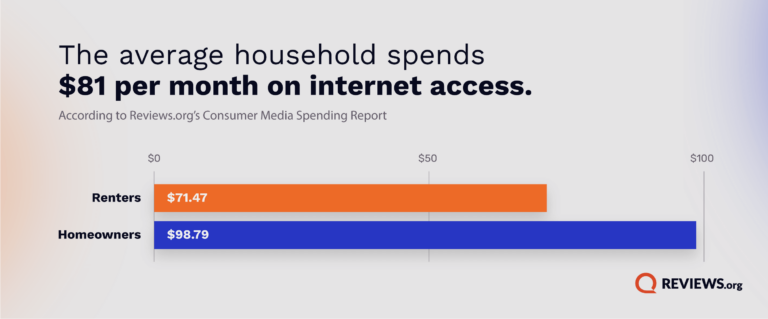
As Reviews.org previously detailed in our State of Consumer Media Spending report, the average household spends $81 each month on internet access. In our affordable connectivity survey, we dug deeper to look for differences between renter and homeowner spending.
Our survey showed that renters spend an average of $71.47 per month on internet, while homeowners spend an average of $98.79. This isn’t surprising, and it’s backed up by NAR research stating homeowner wealth is about 40 times higher than renters’. (Although it’s also possible that homeowners pay more because they need faster speeds (which cost more) to support a larger number of Wi-Fi users, including spouses and kids.)
But if homeowners are that much wealthier than renters, it’s interesting that renters pay about three-quarters as much for internet access as homeowners do. In other words, people with less money may spend more of their income on internet access.
Cost is most important to internet consumers
Unsurprisingly, cost is the most important factor to consumers when choosing an internet provider. In our survey, 34% of respondents put cost as their number-one concern, followed by reliability at 33.2%, then speed and performance at 29.5%.
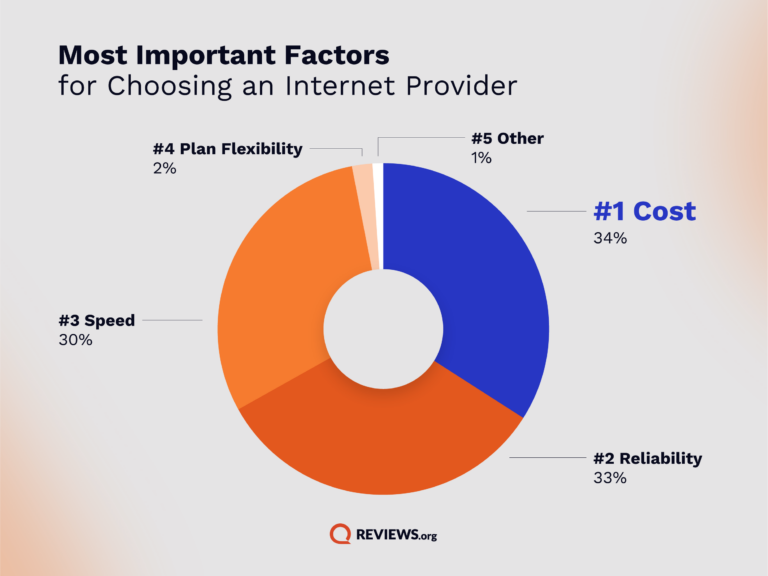
Notably, we saw different trends when we split the answers by homeowners and renters.
Homeowners ranked internet reliability as their top priority. The breakdown is as follows:
- Reliability (36.51%)
- Cost (32.15%)
- Speed/performance (27.57%)
- Flexibility to choose a provider (2.94%)
Meanwhile, renters put cost first:
- Cost (38.72%)
- Reliability (31.63%)
- Speed/performance (27.87%)
- Flexibility to choose a provider (0.49%)
Although cost is the top concern, neither homeowners nor renters have the luxury of shopping around for an affordable price.
Internet service areas are limited by infrastructure. Consumers must pick between whichever providers have built a network where they live. If none of those providers comes at a cost they can afford, they’re in trouble. That’s where programs like the ACP come in.
Affordable internet statistics
How many people are aware of and use the ACP and other similar government assistance programs? Here’s what we found.
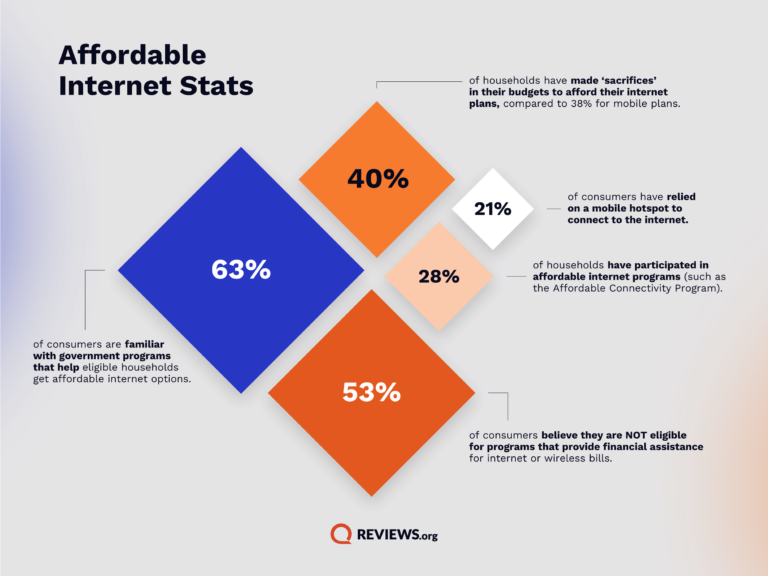
- 63% of consumers are familiar with government programs or subsidies that help eligible households get affordable internet options.
- 53% of consumers believe they are NOT eligible for programs that help pay for internet or wireless bills.
- 40% of households have made 'sacrifices' in their budgets to afford their internet plans, compared to 38% for mobile plans.
- 28% of households have participated in affordable internet programs (such as the Affordable Connectivity Program).
- 21% of consumers have relied on a mobile hotspot to connect to the internet.
Awareness of government assistance programs
It turns out that a lot of Americans are aware of government assistance programs that help eligible consumers receive affordable internet. In our survey, 63% of consumers said they were familiar with these programs.
If you’re not familiar but would like to be, you can always check out our low-income internet guide and our article on lowering your internet bill. These resources talk about the ACP and ways to cut the costs you spend on internet access.
Participation in government assistance programs
Although government internet assistance awareness is high, participation is lower. According to our survey, just 28% of households have participated in programs that provide financial assistance for affordable internet options.
We don’t have data on the percentage of households eligible for these programs, so it’s not clear whether a high or low fraction of eligible households participate. However, it makes sense that participation skews lower than awareness, considering that the ACP is available only to internet users who qualify for certain government assistance programs.
Eligibility for government assistance programs
In order to take advantage of the ACP, at least one member of your household needs to meet certain criteria. They either need to participate in the free and reduced-price school lunch or school breakfast program; receive a Federal Pell Grant in the current award year; or be enrolled in the Special Supplemental Nutrition Program for Women, Infants, and Children (WIC). There are other options too—see our full guide on the ACP for more info.
It turns out that a lot of Americans feel left out of the ACP benefit. Our survey shows 53% of consumers believe they are not eligible for financial assistance with their internet or wireless bills.
Find the cheapest high-speed internet plans in your area.
Affordable internet plans: promo prices and equipment fees
Provider and plan | Promotional price | Equipment rental fee | Download speeds | Details |
| $50/mo. w/ AutoPay, plus taxes & fees.* | $10.00/mo. | Up to 354 Mbps Mbps | View Plans | |
| $35/mo.† | $15.00/mo. | Up to 300 Mbps Mbps | View Plans | |
| $40/mo. for 1 yr.‡ | $5.00/mo. | Up to 500 Mbps Mbps | View Plans | |
| $30/mo.^ | $10.00/mo. | Up to 300 Mbps Mbps | View Plans | |
| $40/mo. for 5 yrs.° | $14.00/mo. | Up to 300 Mbps Mbps | View Plans |


*
w/AutoPay. Guarantee exclusions like taxes and fees apply.
†
Price includes $10/mo. discount when you sign up for paperless billing and AutoPay with a debit card or bank account. Or $5/mo. with a credit card.
‡
Limited-time offer; subject to change; new residential customers only (no Spectrum service in past 30 days). Standard rates apply after promo period or service change. Actual speeds (including wireless) vary and are not guaranteed. Activation fee additional; taxes may apply. Gig speeds require a compatible modem; see spectrum.net/modem for list. Terms and conditions apply, subject to change. Not available in all areas. Restrictions apply. Spectrum Internet® is powered by fiber and connected to the premises by coaxial lines.
^
w/ $10/mo. elig. Auto Pay & Paperless Bill. Wired connection. WiFi speeds may vary. Not available in all areas.
°
New Xfinity Internet customers. Limited to 300 Mbps internet. Requires both paperless billing and automatic payments with stored bank account (or additional $10/mo charge applies). Installation, taxes and fees, and other applicable charges extra, and subj. to change. Service limited to a single outlet. Internet: Actual speeds vary and are not guaranteed. For factors affecting speed visit www.xfinity.com/networkmanagement.
Alternative internet access methods
So what happens if someone is renting and strapped for cash but doesn’t qualify for financial internet assistance? Luckily, there are other ways to access the internet.
While some folks surely opt to use their library or school Wi-Fi, mobile hotspots are surprisingly popular. An impressive 21% of consumers say they’ve relied on a hotspot from their phone to connect to the internet.
Usually, though, people can’t get by without a regular internet plan, so they’re left with scrimping and saving. Notably, 40% of households have made “sacrifices” in their budgets to afford their internet plans. As a comparison point, 38% make comparable sacrifices to afford mobile plans. That may explain why some folks opt for hotspots instead of a separate internet plan.
However you dice the data, consumers are struggling to afford internet access, and programs like the ACP help with that gap. Without them, accessing internet may become even more of a financial concern.
Methodology
To get the data we use in this piece, Reviews.org surveyed 1,000 Americans 16 years and older in October 2023 with a +/- 4% margin of error and a confidence level of 95%.
We also reference a previous study we did about the state of consumer media spending.

Related Articles
GFiber (formerly Google Fiber) Internet Review: My Honest Experience After Two Years
Google Fiber offers fast download speeds at an affordable price, so what’s not to like?...

What Age Should Your Kid Get a Phone?
When should you get your kid a phone? A smartphone? A social media account? Find...
gFiber Internet Plans and Deals (2026)
Read about Google Fiber Internet prices, plans, and deals for high-speed internet.

GFiber vs. T-Mobile 5G Home Internet: What’s Better?
Deciding between T-Mobile or Google Fiber for your home internet? Here’s what to sign up...



